
My Soil, My Deorai
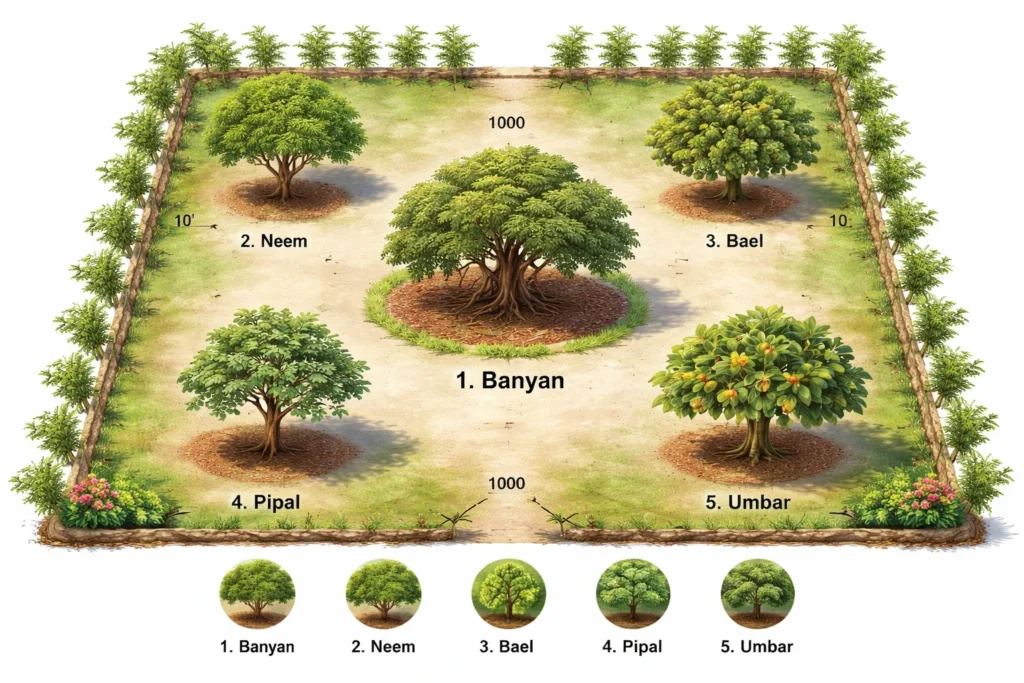
A Living Ecosystem from One Guntha
“My Soil, My Deorai” is a regenerative land transformation model where even a small land parcel is converted into a self-sustaining mini-forest ecosystem. The goal is to move beyond conventional land use and design land as a living ecological system that continuously regenerates soil, water, biodiversity, and climate value.
Instead of treating land only as a production asset, this model restores it as a biological infrastructure, a living network of trees, microbes, insects, birds, and soil carbon.
In every 1 guntha, we establish 5 keystone native trees, each selected for a specific ecological function. Together, they create a multi-layered, self-regulating ecosystem.
1. Vad (Banyan) – Ficus benghalensis
The Keystone Ecosystem Engineer
Ecological importance:
- Supports 200+ species of birds, insects, and mammals
- Can develop aerial root systems that stabilize soil structure
- Long lifespan: often 200–500+ years, creating permanent habitat zones
Environmental functions:
- Mature trees can store up to 10–15 tons CO₂ equivalent over time
- Provides year-round shade, reducing soil evaporation by 20–30% locally
- Acts as a natural biodiversity hub (mini-forest within a tree)
Ecosystem role: “Living apartment complex for biodiversity”
2. Peepal (Sacred Fig) – Ficus religiosa
The Continuous Oxygen & Climate Regulator
Ecological importance:
- Photosynthesis in low light and night respiration balance improves local air quality
- One of the most efficient native trees for microclimate stabilization
- Supports 150+ insect and bird species
Environmental functions:
- Large leaf surface contributes to dust capture and air purification
- Helps reduce ambient temperature by 1.5–3°C in surrounding area
- Strong carbon fixation capacity: approx. 20–25 kg CO₂/year per mature tree
Ecosystem role: “Natural air purifier and temperature stabilizer”
3. Umbar (Cluster Fig) – Ficus racemose:
The Wildlife Food Security Tree
Ecological importance:
- Produces fruit clusters 3–4 times a year, ensuring continuous food supply
- Critical for birds like parakeets, bulbuls, and fruit bats
- Important for pollination networks and seed dispersal systems
Environmental functions:
- High interaction with pollinating wasps → supports fig–wasp mutualism
- Improves soil nutrient cycling through leaf litter decomposition
- Enhances microbial diversity in rhizosphere
Ecosystem role: “Permanent food source for wildlife”
4. Bael (Wood Apple) – Aegle marmelos
The Medicinal & Pollinator Support Tree
Ecological importance:
- Highly drought-tolerant (survives in low rainfall zones <500 mm/year)
- Flowers attract bees, butterflies, and native pollinators
- Important ethnobotanical species in Indian agroforestry
Environmental functions:
- Deep root system improves soil aeration and water infiltration
- Enhances resilience of surrounding crops during drought stress
- Leaves and fruit support organic matter recycling
Ecosystem role: “Medicinal resilience and pollinator magnet”
5. Neem – Azadirachta indica
The Natural Pest Regulator
Ecological importance:
- Contains bioactive compounds (azadirachtin) that naturally suppress pests
- Supports 100+ insect species but selectively inhibits harmful pests
- Widely used in organic farming systems
Environmental functions:
- Reduces pest population pressure on nearby crops by 30–70% in integrated systems
- Improves soil health through nutrient-rich leaf litter
- Sequesters carbon ~20–30 kg CO₂/year per young tree (higher when mature)
Ecosystem role: “Living plant protection system”
Bamboo Boundary System – The Ecological Shield
Surrounding every micro-forest is a bamboo plantation, functioning as a high-performance ecological boundary.
Key contributions:
Carbon & Biomass Powerhouse
- Bamboo grows up to 3–5 feet per day in peak season
- Sequesters up to 30–60 tons of CO₂ per hectare annually
Wind & Microclimate Barrier
- Reduces wind speed by 20–50%
- Protects young trees and improves moisture retention
Biodiversity Corridor
- Provides nesting for birds and shelter for insects
- Connects fragmented habitats across agricultural landscapes
Rural Economy Resource
Supports sustainable raw material systems
Harvestable every 3–4 years without replanting
My Soil My Deorai
This model is not plantation, it is soil ecosystem engineering.
Key soil-level impacts:
- Soil organic carbon increase: gradual improvement of 0.3–1.5% over time
- Microbial activity boost: up to 3–5x increase in beneficial soil microbes
- Water infiltration improvement: reduces runoff by 30–60%
- Erosion control: root networks stabilize topsoil significantly
Creating Habitat, Not Just Trees
Each “My Soil, My Deorai” unit becomes:
- A nesting and feeding ecosystem for birds
- A pollinator sanctuary for bees and butterflies
- A microclimate regulator for surrounding farms
- A living carbon sink embedded in agricultural land
- A microbial biodiversity hotspot in soil
Cultural + Ecological Integration
This model aligns traditional ecological wisdom with modern climate science:
| Sr. No. | Tree | Cultural Value | Ecological Role |
| 1 | Banyan | Sacred village tree | Biodiversity keystone |
| 2 | Peepal | Spiritual oxygen tree | Climate stabilizer |
| 3 | Umbar | Sacred fig species | Wildlife food system |
| 4 | Bael | Temple offering tree | Pollinator + medicinal |
| 5 | Neem | Village pharmacy tree | Natural pesticide system |
“My Soil, My Deorai” is not just plantation, it is the redesign of land into living infrastructure for climate, biodiversity, and future agriculture. This integration revives the concept of sacred groves in a modern regenerative framework.
📞 Build Healthier Soil & Bio-diversity Naturally
Adopt nature-based agricultural solutions to improve soil performance, crop resilience, and sustainable farming outcomes.