
My Soil My Carbon
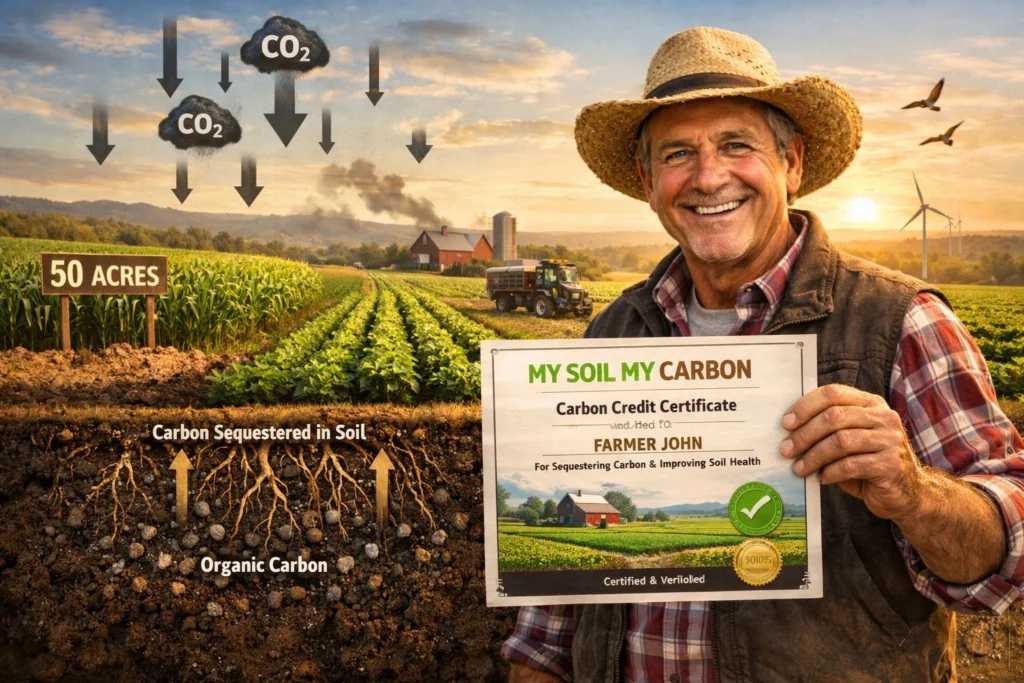
My Soil My Carbon
Transforming Sustainable Farming into Financial Opportunity
Agriculture is evolving from a food production system into a climate solution economy. Every regenerative practice on farm is no longer only an ecological action—it is becoming a measurable, verifiable, and tradable climate asset.
“My Soil My Carbon” is a science + technology + market integration platform that enables farmers, FPOs, agribusinesses, and institutions to participate in the global carbon economy through verified soil carbon sequestration and emission reduction.
Carbon Credits in Agriculture
A carbon credit represents:
1 metric ton of CO₂ equivalent (tCO₂e) reduced or removed from the atmosphere
In agriculture, these credits are generated when farming systems:
- Store more carbon in soil (soil organic carbon)
- Reduce greenhouse gas emissions (CO₂, CH₄, N₂O)
- Improve ecosystem efficiency and reduce chemical dependency
These credits are then certified, verified, and traded in voluntary or compliance carbon markets, creating a new income stream for farmers.
Agriculture Generates Carbon Credits
Carbon sequestration and emission reduction happen through regenerative practices such as:
- No-tillage / conservation agriculture
- Cover cropping and multi-cropping systems
- Agroforestry and tree-based farming
- Crop residue recycling instead of burning
- Reduced synthetic fertilizer usage
- Bio-inoculants and microbial interventions
- Efficient irrigation (drip, micro-irrigation)
- Organic carbon enhancement practices
- Methane and nitrous oxide reduction strategies
- Long-term biomass accumulation in plants and soil
These practices collectively improve:
Climate resilience of farming systems
Soil organic carbon (SOC)
Microbial biomass
Water retention capacity
Nutrient cycling efficiency
MRV SYSTEM – The Core of Carbon Credibility
MRV stands for Measurement – Reporting – Verification
It is the scientific backbone of carbon credit generation.
Without MRV, carbon credits have no value in global markets.
1. MEASUREMENT
“What is happening on the farm?”
We measure baseline and ongoing changes using:
GIS + Satellite Monitoring
- Land use classification
- Vegetation indices (NDVI, EVI)
- Biomass growth tracking
- Crop pattern detection
Soil Sampling & Lab Analysis
- Soil Organic Carbon (SOC)
- Bulk density
- Soil moisture & texture
- Nutrient profile (NPK + micronutrients)
Farm Digital Data
- Crop calendar tracking
- Input usage (fertilizers, chemicals)
- Irrigation practices
- Farm activity logging
Output: Baseline carbon stock + ongoing sequestration estimate
2. REPORTING
“What is being claimed?”
All collected data is converted into:
- Digital farm carbon profiles
- Standardized carbon accounting reports
- Practice-based emission reduction records
- Geo-tagged farm datasets
Technology used:
- Cloud-based farm registry
- Blockchain-enabled traceability (for audit integrity)
- AI-based carbon estimation models
- Automated report generation systems
Output: Transparent, structured carbon project documentation
3. VERIFICATION
“Is it real and credible?”
Independent validation ensures carbon credits are legitimate:
Verification methods:
- Third-party auditing agencies
- Remote sensing validation
- Field inspections (sample-based)
- Statistical carbon modeling verification
- Cross-checking satellite vs ground data
Output: Certified carbon credits eligible for trading
📞 Build Healthier Soil Naturally
Adopt nature-based agricultural solutions to improve soil performance, crop resilience, and sustainable farming outcomes.