
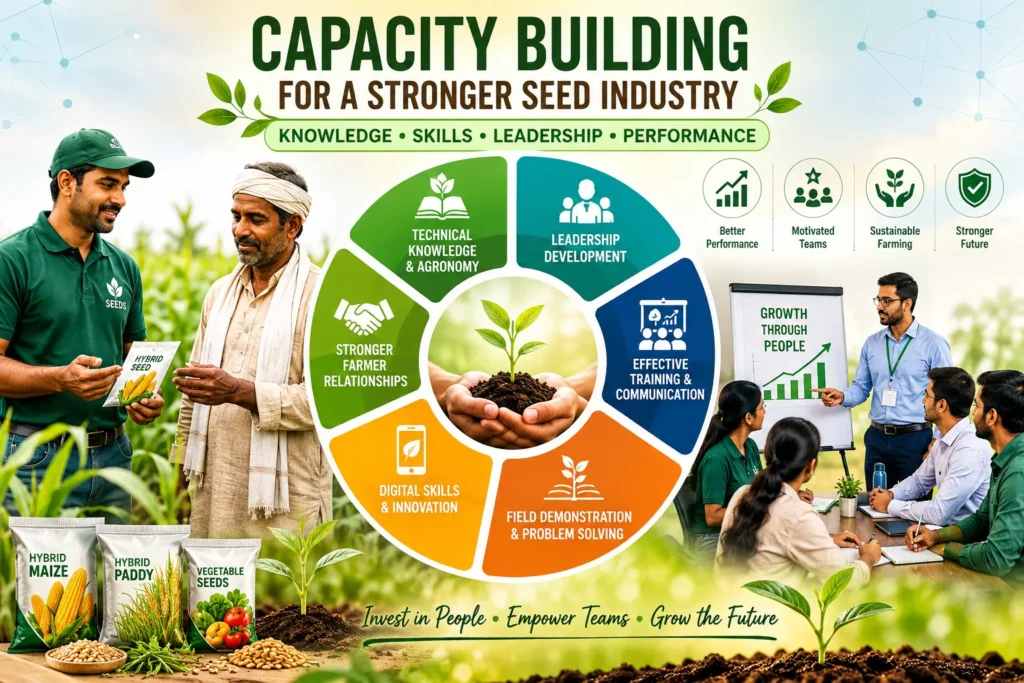
For Field Force and Mid-Level Leaders
The seed industry is one of the most knowledge-intensive sectors in agriculture. From genetics and biotechnology to agronomy, crop protection, farmer engagement, and market intelligence, success depends not only on quality products but also on the people who communicate, position, and support those products in the field.
In today’s competitive agricultural ecosystem, seed companies are realizing that sustainable growth cannot be achieved only through research and product development. The real differentiator lies in the strength of their field force and the effectiveness of their mid-level leadership teams. This makes capacity building a strategic investment rather than an optional training activity.
Why Capacity Building Matters in the Seed Industry
Rapidly Changing Agricultural Landscape
Agriculture is evolving rapidly due to:
- Climate variability
- Pest and disease shifts
- Digital agriculture tools
- New hybrids and varieties
- Precision farming technologies
- Farmer awareness and expectations
Field teams must continuously upgrade their technical knowledge and communication skills to remain relevant and credible among progressive farmers, dealers and channel partners.
A well-trained field force can confidently explain:
- Stress tolerance
- Yield advantages
- Variety performance
- Crop advisory practices
- Economic benefits for farmers
- Nutrient and water management
Without regular capacity building, even the best seed products may fail to reach their market potential.
Strengthening farmer trust through knowledge
Farmers today seek solution providers rather than product sellers. They expect scientific guidance, local recommendations, and practical demonstrations.
When field officers possess strong technical understanding and problem-solving ability, they become trusted advisors. This directly influences:
- Farmer loyalty
- Brand credibility
- Repeat purchases
- Market penetration
- Demonstration success
Knowledge-driven engagement creates long-term relationships instead of seasonal transactions.
Role of mid-level leadership teams
Mid-level managers act as the bridge between company strategy and field execution. Their role is critical in:
- Team motivation
- Territory planning
- Conflict resolution
- Training execution
- Market intelligence
- Performance monitoring
- Dealer and distributor management
However, many organizations promote technically strong employees into managerial roles without leadership development.
This often creates challenges such as:
- Low accountability
- Poor communication
- Weak team coordination
- Resistance to innovation
- Limited mentoring capability
Capacity building programs for leadership teams help develop:
- Strategic thinking
- Team management
- Data-driven planning
- Emotional intelligence
- Decision-making skills
- Coaching and mentoring abilities
Strong leaders create strong field teams.
Technical training alone is not enough
Modern seed industry training must go beyond product information.
A comprehensive capacity building program should include:
- Farmer psychology
- Market positioning
- Climate-smart agriculture
- Problem-solving approaches
- Seed production fundamentals
- Agronomy and crop management
- Digital tools and GIS applications
- Data collection and reporting systems
- Communication and presentation skills
- Carbon farming and sustainability concepts
The integration of technical, managerial, and behavioral competencies creates high-performing teams.
Importance of field demonstration skills
In the seed business, “seeing is believing.”
Field teams must be trained in:
- Data recording
- Farmer field days
- Crop observations
- Comparative trials
- Demo plot establishment
- Visual communication techniques
Effective demonstrations convert scientific performance into farmer confidence.
Digital transformation requires new skills
The seed sector is increasingly adopting:
- GIS mapping
- CRM platforms
- Drone technologies
- AI-based forecasting
- Mobile advisory systems
- Digital extension services
Capacity building ensures that field and managerial teams can effectively use these technologies for:
- Crop monitoring
- Market forecasting
- Better farmer engagement
- Data-driven decision making
Organizations that invest in digital literacy gain a significant competitive advantage.
Building organizational culture and retention
Training programs also improve employee motivation and retention.
Employees who receive regular learning opportunities feel:
- Valued by the organization
- More confident in their roles
- Better prepared for career growth
This helps reduce attrition and creates a culture of continuous learning and innovation.
In an industry where relationships and regional expertise matter greatly, retaining experienced talent becomes a major strategic advantage.
Capacity building as a business investment
Many companies still view training as an expense. In reality, it is one of the highest-return investments in the seed business.
A skilled and motivated field force can:
- Increase sales efficiency
- Strengthen dealer networks
- Enhance product positioning
- Build long-term brand loyalty
- Reduce market misinformation
- Improve farmer conversion rates
Similarly, empowered mid-level leaders improve operational efficiency and organizational alignment.
Conclusion
The future of the seed industry will be shaped not only by genetics and innovation but also by the capability of the people delivering those innovations to farmers.
Continuous capacity building for field force and mid-level leadership teams is essential to:
- Improve farmer engagement
- Accelerate technology adoption
- Strengthen market competitiveness
- Build resilient agricultural ecosystems
Seed companies that invest in knowledge, leadership, and human capital today will become the most trusted agricultural partners of tomorrow.
In agriculture, products may create entry into the market, but people create lasting impact.