The agricultural industry is entering a new biological revolution. Farmers across the world are increasingly hearing terms such as microbial consortia, bio fertilizers, bio stimulants, soil biology, carbon farming, regenerative agriculture, and residue decomposition. Yet, despite the growing interest, marketing biological products to farmers remains one of the most challenging tasks in agriculture.
Why?
Because biologicals are not simply “products”.
They are living systems, ecological interactions, and biological processes.
Unlike conventional agrochemicals, where visible effects are often immediate and measurable, biologicals work through complex interactions involving soil microbes, plant roots, climate, organic matter, and ecosystem balance. Therefore, biological marketing is fundamentally “concept selling.”
Biologicals cannot be sold like chemicals
Suresh, a progressive sugarcane farmer from Kolhapur, western Maharashtra, had always believed in “visible results.” Like many farmers, his buying decisions were simple and practical.
If an insecticide killed pests quickly, it was good.
If urea turned the crop greener in three days, it was effective.
If a herbicide cleaned the field within a week, it was worth the money.
For years, agriculture input companies’ marketed products to him with straightforward promises:
- Faster pest kill
- Greener crop in 3 days
- Immediate nutrient availability
- Quick weed control
And honestly, these products worked exactly as expected.
One season, a field officer from a biological company visited his farm and introduced a microbial consortium for soil health improvement.
The officer explained:
“This product improves nutrient cycling, stimulates root growth, increases microbial activity, and improves soil carbon.”
Suresh looked confused.
He asked a simple question:
“Will my crop become greener in 3 days?”
The field officer smiled and replied:
“No… not exactly.”
Suresh immediately lost interest.
Because farmers are trained by experience to look for immediate visual responses. They trust what they can quickly see.
The difference between chemistry and biology
A week later, the field officer returned and sat with Suresh under a neem tree beside the sugarcane field. Instead of talking about products, he started talking about soil.
He picked up a handful of soil and asked: “Do you think this soil is alive?”
Ramesh laughed and replied: “Soil is soil. What is alive in it?”
The officer explained: “One teaspoon of healthy soil can contain billions of microorganisms — bacteria, fungi, actinomycetes, protozoa, all working like a living factory underground.”
Suresh became curious.
The officer continued: “When you apply urea, it directly feeds the crop. But when you apply biologicals, you are feeding the soil ecosystem that will support the crop for years.”
A simple analogy changed everything
The officer gave Suresh an example.
“Chemical farming is like giving glucose injections to a weak person. The person feels energetic immediately.
But biological farming is like improving digestion, immunity, and long-term health through balanced nutrition and exercise. The improvement is slower, but sustainable.”
Now Suresh understood.
The officer explained further:
- Urea supplies nitrogen instantly. But nitrogen-fixing bacteria slowly capture atmospheric nitrogen.
- Chemical fungicides directly kill pathogens. But beneficial fungi like Trichoderma build a protective microbial shield around roots.
- Chemical fertilizers feed plants. Biologicals improve the soil’s ability to feed plants naturally.
One gives immediate visible reaction. The other rebuilds the system itself.
The first failure
Still unsure, Suresh agreed to try the biological product on one acre. But after 10 days, he complained: “I don’t see any major difference.” The officer visited the field again and observed several things:
- Soil organic carbon was very low.
- The field had received heavy fungicide applications previously.
- Irrigation was irregular.
- Crop residue was burned every season.
The officer explained: “Biologicals are living organisms. They need suitable conditions to survive and perform.”
He compared it to dairy farming: “If you buy a high-yield cow but do not provide water, feed, or shelter, the cow cannot perform well. Similarly, beneficial microbes also need a healthy environment.”
That was the turning point.
Understanding the ecosystem
Over the next season, Suresh gradually changed some practices:
- He stopped burning crop residue.
- Added organic matter to the soil.
- Reduced excessive chemical sprays.
- Improved irrigation scheduling.
- Used decomposer cultures.
Slowly, changes began appearing:
- Soil became softer.
- Water retention improved.
- Root growth increased.
- Fertilizer efficiency improved.
- Crop stress reduced during dry spells.
Most importantly, input costs slowly started reducing. The improvement was not dramatic like a chemical spray. It was gradual. Cumulative. Biological.
The realization
One evening during harvest, Suresh told neighboring farmers: “Chemicals work like instant painkillers. Biologicals work like rebuilding the body itself.”
He realized biologicals could not be evaluated using the same expectations as chemicals. A pesticide may show results within hours. But restoring soil biology may take seasons. Improving soil carbon may take years. Building resilient farming ecosystems is not an overnight process.
Why biologicals require Education
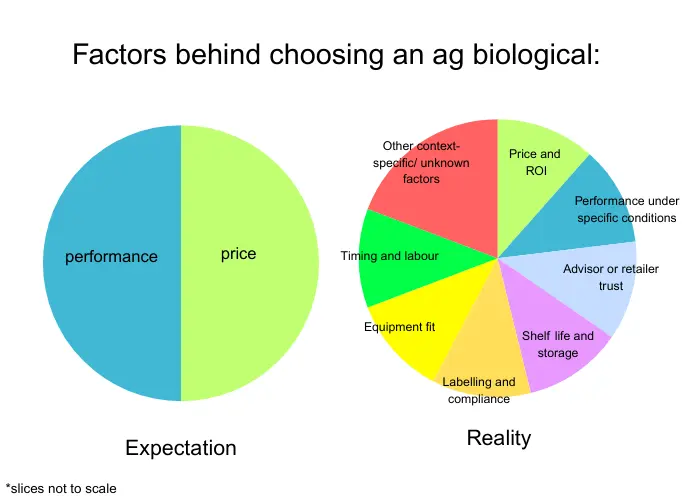
The field officer later explained during a farmer meeting: “Biologicals cannot be sold only through brochures, discounts, or dealer schemes. Farmers must first understand the science behind them.”
Because biological success depends on many factors:
1. Soil organic carbon 5. Existing microbial population
2. Moisture availability 6. Chemical load in soil
3. Crop stage 7. Farming practices
4. Temperature 8. Spoil pH
The same biological product may perform differently in different farms because every farm ecosystem is unique. That is why biologicals are not merely inputs. They are ecosystem technologies.
Biological marketing requires deep understanding
A biological sales professional cannot succeed with only product brochures and pricing sheets. Effective biological marketing requires in-depth understanding of:
1. Soil science
The marketer must understand:
- Soil texture (Sand, Silt, Clay)
- Soil structure (Granular, Blocky, Platy …)
- Soil organic carbon (0.5, 0.75, 1.0 %)
- Soil pH (Acidic, Neutral, Alkaline)
- Soil EC (1. 1.5, 2.5….ds/m)
- Nutrient dynamics (Quantity, Availability, NUE)
- Rhizosphere interactions (Roots, Microbes, Nutrients)
- Water holding capacity (20, 40, 60%)
Without understanding soil health, it is difficult to explain why a biological may work differently from one farm to another.
2. Crop physiology
Every crop interacts uniquely with biology.
For example:
- Legumes naturally associate with nitrogen-fixing bacteria.
- Sugarcane responds strongly to microbial nutrient mobilization.
- Grapes benefit from improved rhizosphere activity and stress resilience.
- Vegetable crops require rapid root establishment and nutrient uptake.
A biological marketer must connect the product mechanism with crop physiology.
3. Ecosystem dynamics
Biologicals are ecosystem-sensitive technologies.
Rainfall, temperature, residue management, irrigation, pesticide history, and biodiversity all influence microbial performance. A knowledgeable marketer understands that farming is not isolated chemistry, it is an ecological system.
4. Microbiology and plant-microbe interactions
The future biological marketer must understand:
- Beneficial bacteria
- Fungi and mycorrhizae
- Enzyme activity
- Nutrient solubilization
- Carbon cycling
- Residue decomposition
- Plant signaling mechanisms
Farmers today increasingly ask:
- “How does this organism work?”
- “Will it survive in my soil?”
- “Can it reduce fertilizer cost?”
- “How long will the effect remain?”
Answering these questions requires scientific confidence and field experience.
Farmers buy confidence, not just bottles
A farmer rarely purchases a biological merely because of packaging or branding. Farmers adopt biologicals when they understand the concept, science, and expected outcome and management practices required
This means biological marketing is heavily dependent on:
- Demonstrations
- Field education
- Farmer meetings
- Soil analysis
- Crop observation
- Long-term relationship building
The sales cycle is slower, but the trust built is deeper.
Biological marketing needs “Knowledge-based teams”
The biological industry cannot rely only on traditional sales approaches. Companies must build:
- Agronomy-driven field teams
- Soil health advisors
- Crop consultants
- Microbiology-trained technical staff
- Data-driven farm support systems
Future biological sales professionals may need skills in:
- GIS-based soil analysis
- Carbon farming concepts
- Regenerative agriculture
- Climate-smart agriculture
- Soil microbial diagnostics
- Precision agriculture tools
The role is evolving from “sales representative” to “ecosystem advisor.”
The Future of Agriculture is Biological
As agriculture faces:
- Soil degradation
- Climate change
- Rising fertilizer costs
- Water scarcity
- Carbon emission concerns
Biologicals will become increasingly important.
However, the success of this industry depends not only on product innovation, but also on the ability to communicate biological concepts effectively to farmers. The companies that invest in farmer education, ecosystem understanding, and scientific advisory systems will lead the next agricultural transformation.
Conclusion
Biological marketing is not about pushing products into the market. It is about translating complex biological science into practical farm solutions. It requires patience, technical expertise, ecosystem understanding, and trust-building.
Traditional chemical products are easier to market because farmers can immediately see the effect.
But biologicals require something deeper:
- Farmer education
- Trust building
- Soil understanding
- Ecosystem awareness
- Long-term thinking
Biological marketing is therefore not product selling. It is concept selling. The future agricultural professional will not simply sell bottles and packets. They will explain biology, restore soil ecosystems, and help farmers transition from input dependency to regenerative farming systems. Because biologicals are not designed merely to grow crops. They are designed to rebuild the living foundation of agriculture itself.
In the coming decade, the most successful agricultural professionals will not merely sell inputs, they will help farmers understand biology, regenerate soils, and rebuild resilient farming ecosystems. Because biologicals are not just products. They are living technologies for the future of agriculture.