
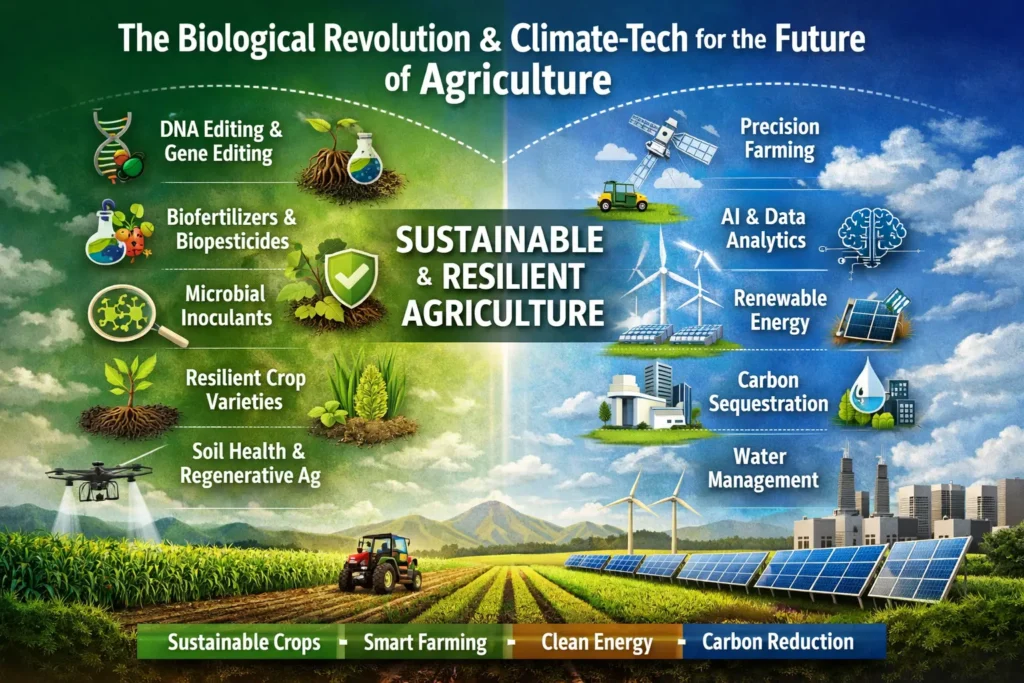
We stand at the edge of a system reset
After green revolution, we built the modern food system to defeat hunger, and it worked to fulfill our food demands. We produced more food than any civilization in history, but with chemicals and mechanization. Supply chains spanned continents by road, rail and air. Productivity soared loudly. Billions were fed with love and care.
But every success came with a hidden cost. The cost was truly devastating! Our soils weakened! Ecosystem collapsed! Carbon accumulated in the atmosphere instead of the rhizosphere!
Today, agriculture sits at the center of the climate crisis. It is responsible for nearly a quarter of global greenhouse gas emissions! Yet it also holds greatest climate solutions beneath our feet!
The next era of climate action will not begin in smokestacks or electric vehicles alone. It will begin in soil. Soil will become a carbon sink.
Food is the largest unmeasured climate system
Every day, farmer work hard to produce food, through supply chain, food travels thousands of kilometers from farms to plates. Every corner of plate have different struggle to reach. But no one counts, even knows the hardship!
Can we answer simple questions?
- How much carbon did this food emit?
- Did producing it regenerate soil or degrade it?
- Did biodiversity increase or decline?
- Did farmers become more resilient?
The enterprise value of global food system to be around USD 14 trillion-dollar economy, but without any environmental accounting. What carbon finance did with accounting standards? Agriculture can do a lot for carbon, ecology and responsible production.
‘Measurement is the first act of transformation’.
Pillars of the climate-positive food system
Who can change the scenario? A new architecture is emerging, which is powered by digitization, carbon accounting, and biological intelligence. It is not an incremental change, it is system redesign.
1. Digitization — Making nature visible
There is strong thought that ‘you cannot manage what you cannot measure’.
AI enabled digitization converts farms into datasets:
- Satellites observe crop health in real time.
- Sensors monitor soil and moisture dynamics.
- AI models predict emissions and sequestration.
- Digital MRV systems verify climate outcomes.
With technology, agriculture becomes measurable at planetary scale on our screens.
Every data turns farming from uncertainty into intelligence and transparency becomes the currency of trust.
2. Carbon Accounting — Turning soil into infrastructure
Earlier, there is a fundamental assumption that ‘Soil is dirt’ but carbon accounting changes to ‘Soil is climate infrastructure’.
When our farmers increase soil organic carbon, they:
- Remove CO₂ from the atmosphere
- Improve water retention
- Increase resilience to drought
- Restore ecosystem function
- Revive micro flora and fauna
Our carbon accounting platform allows this invisible work to be quantified, verified, and rewarded. Thus farmer becomes not only a food producer but also climate engineer. Then agriculture will shift from being an emission problem to a sequestration platform.
3. Biologicals — Reawakening earth’s original technology
Before devastating synthetic inputs, every field of agriculture relied on soil biology.
- Microbes built soil fertility.
- Fungi transported nutrients.
- Plant–microbe symbiosis regulated ecosystems.
Earth’s oldest technology ‘Biologicals’ return to the most advanced technology which using microbial solutions.
These biologicals solution can enable:
- Nutrient efficiency without excess chemicals
- Carbon stabilization in soils
- Reduced nitrous oxide emissions
- Regenerative productivity
Any technology does not replace nature, it enables nature to scale again.
The Convergence Moment
Considering individually, these innovations matter. But together, they have strong push and pull to redefine relationship with food.
- Digitization measures.
- Biologicals regenerates.
- Carbon accounting validates.
Let’s work on this convergence which creates something entirely new thoughts for farmers, agri-business and supply chain ecosystem.
- The climate positive supply chain.
- Food becomes traceable not just geographically, but ecologically.
- Every harvest carries a climate outcome.
A New Economic Model for Farmers
For generations, our farmers have been paid only for their yield. Upcoming climate finance flows not only to energy transitions but into rural farms and fields. The farmer becomes the steward of planetary stability and agriculture becomes largest distributed climate solution.
So our farmers will be rewarded for following outcomes:
- Carbon stored
- Soil restored
- Water conserved
- Biodiversity enhanced
Why We Will Lead This Transition
Reboot Agri is an agriculture science, technology and climate solutions company focused on enabling sustainable agriculture, soil health restoration, and carbon-smart farming through digital and biological innovations.
The company works at the intersection of regenerative agriculture, carbon accounting (dMRV), and farmer-centric advisory, helping farmers, enterprises, and development programs transition toward climate-resilient and low-emission agricultural systems.
Reboot Agri believes:
- Soil is the largest untapped climate solution.
- Farmers are climate leaders waiting to be recognized.
- Data must connect ecosystems to economies.
- Biology is the foundation of sustainable productivity.
- Carbon accounting must become as standard as financial accounting.
- Food systems must regenerate more than they extract.
Reboot Agri integrates:
- Soil health & microbial diversity
- Satellite and IoT intelligence
- Digital monitoring, reporting, and verification (dMRV) platforms
- Carbon sequestration and climate project implementation
- Farmer engagement and capacity building
- Sustainability and carbon market readiness
On mission mode, we empower farmers, businesses and agriculture organizations with data-driven and nature-positive solutions that enhance productivity while restoring soil carbon and ecosystem health.